
Moving to Spain: All Residency Routes in 2026
I help people relocate to Spain legally — from choosing the right visa strategy to holding your TIE card (Spanish residence document) in hand. I live and work here in Valencia, have been running cases for 3+ years, and know exactly where applicants lose time, money, and nerves.
Whether you're a remote worker keeping your US or UK income, a retiree looking for sunshine, or an entrepreneur ready to open up in Europe — there is a legal route for you.

Figures below are illustrative ranges. Requirements vary by individual case and are updated by Spanish authorities. We verify all current rules and documents before any submission.
Find Your Situation
Relocating to Spain starts with identifying the right route. Your country of origin, income type, employment status, and family situation all determine which path fits — and which documents you'll need.
I work remotely
Digital Nomad Visa — live in Spain, keep your US/UK/Canadian income, work legally.
Learn more →I want to settle permanently
All residency options: work permit, study, family, and more.
Learn more →I have passive income or I'm retiring
Non-Lucrative Visa (non-working residency) — popular with FIRE retirees and pensioners.
Learn more →I need a visa first
Tourist, work, student — understand what starts the clock.
Learn more →9 Legal Routes to Spanish Residency in 2026
The most common mistake is assuming there is one "correct visa for everyone." In practice, the best route depends on your income type, profession, family situation, and where you'll be applying from. Below are all working pathways with real-world figures.
Numbers: EUR is the source of truth. USD/GBP equivalents are approximate and FX-dependent. Thresholds are reviewed when Spanish authorities update SMI/IPREM.
| Route | Best for | Min. income / requirement | Processing time | Permit duration | Work rights | Spanish tax residency triggered (183+ days) | |
|---|---|---|---|---|---|---|---|
| Digital Nomad Visa | Remote workers, IT, freelancers | 200% SMI (€2,849/mo) | 1–3 mo | 3 yrs + 2-yr renewal | Remote only | No | Details → |
| Non-Lucrative Visa | Retirees, FIRE, passive income | 400% IPREM (€2,400/mo, €28,800/yr; IPREM €600/mo) | 2–4 mo | 1 yr + renewals | No | Yes | Details → |
| Work Permit (cuenta ajena) | Employed by Spanish company | Job contract with Spanish employer | 2–6 mo | 1 yr + up to 4 yrs | Yes | Yes | Details → |
| Autónomo (cuenta propia) | Self-employed, sole traders | Business plan + funds | 2–6 mo | 1 yr + renewals | Yes — own business | Yes | Details → |
| Student Visa | Students, language courses | Course fees + ~€600/mo | 1–2 mo | 1 yr + study duration | Up to 30 hrs/wk | Yes | Details → |
| Arraigo (regularization) | Already living in Spain | Proof of residence | 3–6 mo | 1 yr + renewal | Yes | Yes | Details → |
| Family Reunification | Relatives of existing residents | Housing + resident's income | 2–4 mo | 1 yr + annual | Depends on type | Yes | Details → |
| Startup / Entrepreneur Visa | Innovative startups | Business plan + innovation approval | 1–4 mo | 3 yrs + 2-yr renewal | Yes | No | Details → |
| Highly Qualified Professional | Senior specialists, executives | Salary from €40,000/yr | 1–2 mo | 2 yrs + renewal | Yes | No | Details → |
Digital Nomad Visa
The Digital Nomad Visa (introduced by Spain's Ley de Startups, Law 28/2022) is designed for people who work remotely for clients or employers outside Spain. You live in Spain; your income stays tied to your existing job or freelance contracts — no Spanish employer required.
This is typically the fastest and cleanest route for US and UK remote workers who want to keep their current income while relocating to Europe.
Taxes. Living in Spain has tax implications both in Spain and in your home country. We are not tax advisers — where tax matters arise, we coordinate with a qualified cross-border tax adviser. A detailed tax guide will follow. (Nothing here is tax advice.)
UK applicants: Post-Brexit, this replaces the freedom of movement you previously had. No job offer needed — just documented remote income.
Full Digital Nomad Visa guide →Non-Lucrative Visa (Non-Working Residency)
The Non-Lucrative Visa (visado de residencia no lucrativa) grants the right to live in Spain without working locally. It is one of the most popular choices for retirees, FIRE adherents, pensioners, and anyone with consistent passive income.
You must not work in Spain — local employment is not permitted. Income from pensions, dividends, rental properties, or savings held abroad is acceptable.
Taxes. Living in Spain has tax implications both in Spain and in your home country. We are not tax advisers — where tax matters arise, we coordinate with a qualified cross-border tax adviser. A detailed tax guide will follow. (Nothing here is tax advice.)
UK applicants: Popular with retirees who previously relied on EEA free movement. Proof of pension or investment income from UK sources is generally accepted at Spanish consulates.
Full Non-Lucrative Visa guide →Work Permit (cuenta ajena) — Employed in Spain
The standard employment-based residence permit. Requires a confirmed job offer from a Spanish company, and the employer must initiate the application on your behalf.
Note: The Spanish labor market has significant unemployment, and salaries in many sectors are lower than northern Europe. This route is worth pursuing if you already have a concrete offer. We help navigate the employer-side procedure.
Autónomo (cuenta propia) — Self-Employed Residency
Autónomo is Spain's self-employed status (equivalent to a sole trader or independent contractor). This route lets you register as self-employed in Spain and work with local or international clients.
Student Visa — Study-Based Entry
Enrolling in a Spanish language course, university degree, or accredited program grants a student residence permit. This is one of the lower-barrier entry routes and gives you time to settle, learn the language, and explore longer-term options.
Arraigo — Regularization for Those Already in Spain
Arraigo (from the Spanish for "rootedness") is a legalization path for people already residing in Spain. There are several subtypes (arraigo socioformativo, arraigo sociolaboral, etc.) with differing requirements.
Choosing the correct subtype is critical. We assess your situation and recommend the right arraigo track.
Family Reunification
If your spouse, partner, or close relative already holds Spanish residency, you may be eligible to join them through family reunification (reagrupación familiar).
Startup / Entrepreneur Visa
Introduced under Spain's Ley de Startups (Law 28/2022), this route targets founders of innovative projects. Approval from a competent body (such as ENISA or an accredited incubator) is required.
Highly Qualified Professional
Fast-track residency for senior professionals and executives relocating to a Spanish-registered employer. Uses Spain's EU Blue Card framework.
Not sure which route fits your situation? We can narrow it down in a 2-minute intake.
Take the quiz →Where to Start: Your Relocation Roadmap
Identify your route
Remote worker with US/UK income? → Digital Nomad Visa. Retiring or have passive income? → Non-Lucrative. Offer from a Spanish employer? → Work permit. Want a softer entry? → Student visa. Already in Spain and need status? → Arraigo.
Assess your budget
A clear budget picture removes the biggest source of pre-move stress. Submit your intake form and we'll calculate a realistic budget for your specific case.
Prepare your documents
The documents you need depend on your country of origin:
- US applicants: FBI Identity History Summary + apostille (US Department of State or Secretary of State); employment/income proof; apostilled civil documents.
- UK applicants: ACRO Police Certificate; FCDO apostille for UK documents.
- Canadian applicants: RCMP certified criminal record check; apostille via Global Affairs Canada (Canada joined the Hague Convention in January 2024).
- All applicants: sworn translations (traducción jurada) into Spanish by a certified Spanish translator.
We provide a complete, case-specific document checklist within one business day of your intake.
File your application
Two main routes: apply via the Spanish consulate in your home country, or in some cases apply while in Spain. The right procedure matters — errors in the appointment process or submission format can cause significant delays.
Receive your permit and settle in
After approval, practical tasks begin: empadronamiento (municipal registration at your local town hall), collecting your TIE card (residence document), opening a bank account, arranging healthcare, schools, and long-term housing. We provide a city-specific post-approval checklist.
What Does Moving to Spain Actually Cost?
"How much does it cost to move to Spain?" is the question on almost every initial call. Without a clear picture, even a well-chosen visa won't protect you from running short in the first months. Costs vary by city, permit type, and family size. The figures below are 2026 reference ranges; EUR is the source of truth.
| Expense | Range (indicative) |
|---|---|
| Application fees (visa / permit filing) | €60–€90 + consulate service fees |
| Document legalization (apostille + sworn translations) | €200–€600 |
| Flights (transatlantic, varies significantly) | €400–€1,200 |
| First month living costs (food, transport, essentials) | €1,200–€3,000 |
| Our advisory services | from €500 |
| Total starting range | €2,100–€5,500 |
USD/GBP equivalents are approximate and FX-dependent.
Note on document costs for US/UK/CA applicants: Obtaining and apostilling your home-country police record adds both cost and lead time to your plan. Factor this into your overall timeline.
The most budget-efficient entry is often the student track (especially language courses) — but it takes longer. The fastest is typically the Digital Nomad Visa when income is clean and documents are ready.
Honest Pros and Cons of Moving to Spain
Climate and lifestyle
Southern regions (Andalusia, Valencia) average 300+ sunny days per year. This isn't a marketing line — it measurably affects daily routines for people coming from grey northern climates.
Schengen access
As an EU/Schengen member, Spain gives you visa-free travel throughout the Schengen Area. For US and Canadian citizens, this replaces the 90/180-day Schengen tourist limit.
Cost of living below northern Europe
Spain is significantly more affordable than France, Germany, or the Netherlands — and dramatically cheaper than London or New York — particularly outside Madrid and Barcelona.
Path to long-term status
The strategic ladder: residence permit → after 5 years, long-term residency (permanent resident status) → after 5 more years, EU citizenship eligibility.
Expat infrastructure
Major cities and coastal areas have coworking spaces, international schools, English-speaking professionals, and established expat communities.
Bureaucracy and timelines
Extranjería (the Spanish immigration authority) is real: appointment wait times, specific format requirements, and delays — especially in Madrid and Barcelona. Budget 2–6 months for permit processing.
Tax implications — plan ahead
Taxes. Living in Spain has tax implications both in Spain and in your home country. We are not tax advisers — where tax matters arise, we coordinate with a qualified cross-border tax adviser. A detailed tax guide will follow. (Nothing here is tax advice.)
Labor market
Spain's unemployment rate is among the highest in Western Europe, and local salaries in most sectors are below northern European levels. The employment-based route needs to be approached with clear-eyed expectations.
Language
Spanish is not optional for comfortable daily life. In tourist zones, English carries you partway — but for banking, healthcare, and building local relationships, even basic Spanish makes a decisive difference.
Rental market
In major cities, competition for quality apartments is intense. Landlords commonly request employment contracts, income proof, or aval (guarantor) — documentation that can be harder to provide as a new arrival.
Why Work With EspañaGo
Contact us directly:
Based in Valencia, Spain (CET) — we reply in English
Real Approvals from Spain's Immigration Authority
Every resolución favorable (official positive decision) below was issued by Spain's Extranjería (immigration office) for a real EspañaGo client. These are language-neutral government documents — the outcome speaks for itself. Personal data is redacted.
Recent favorable resolutions from Spain's immigration office
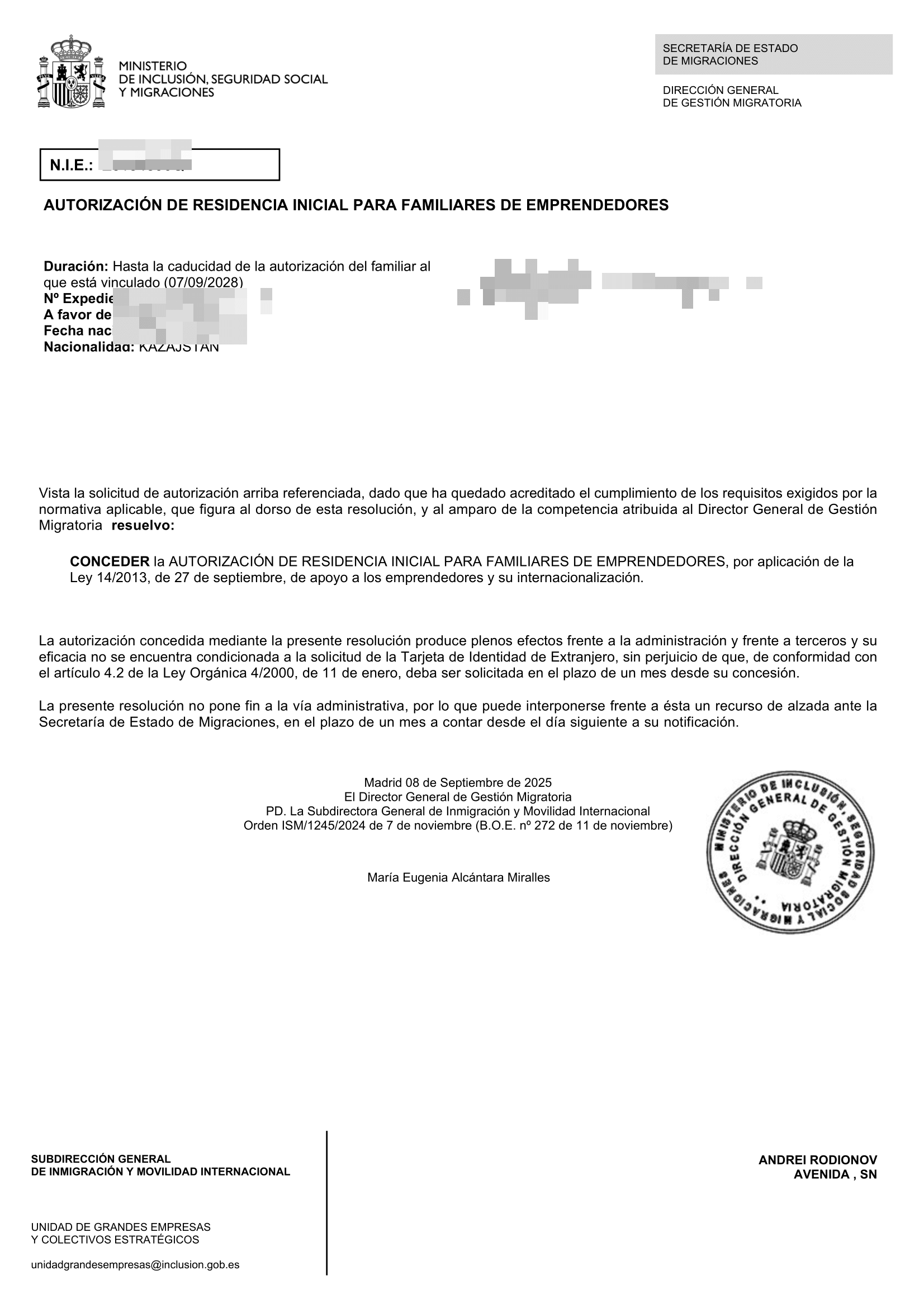
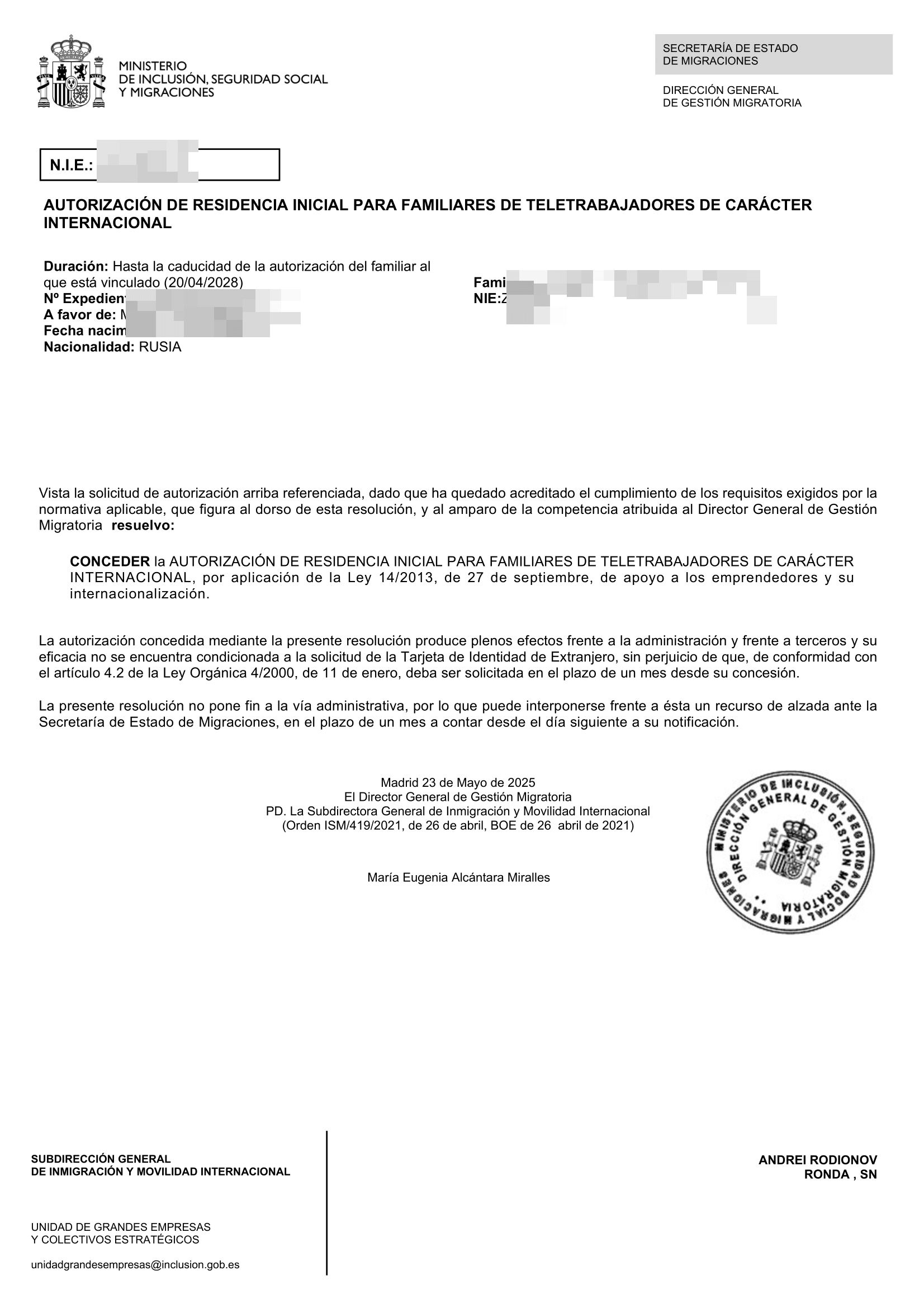
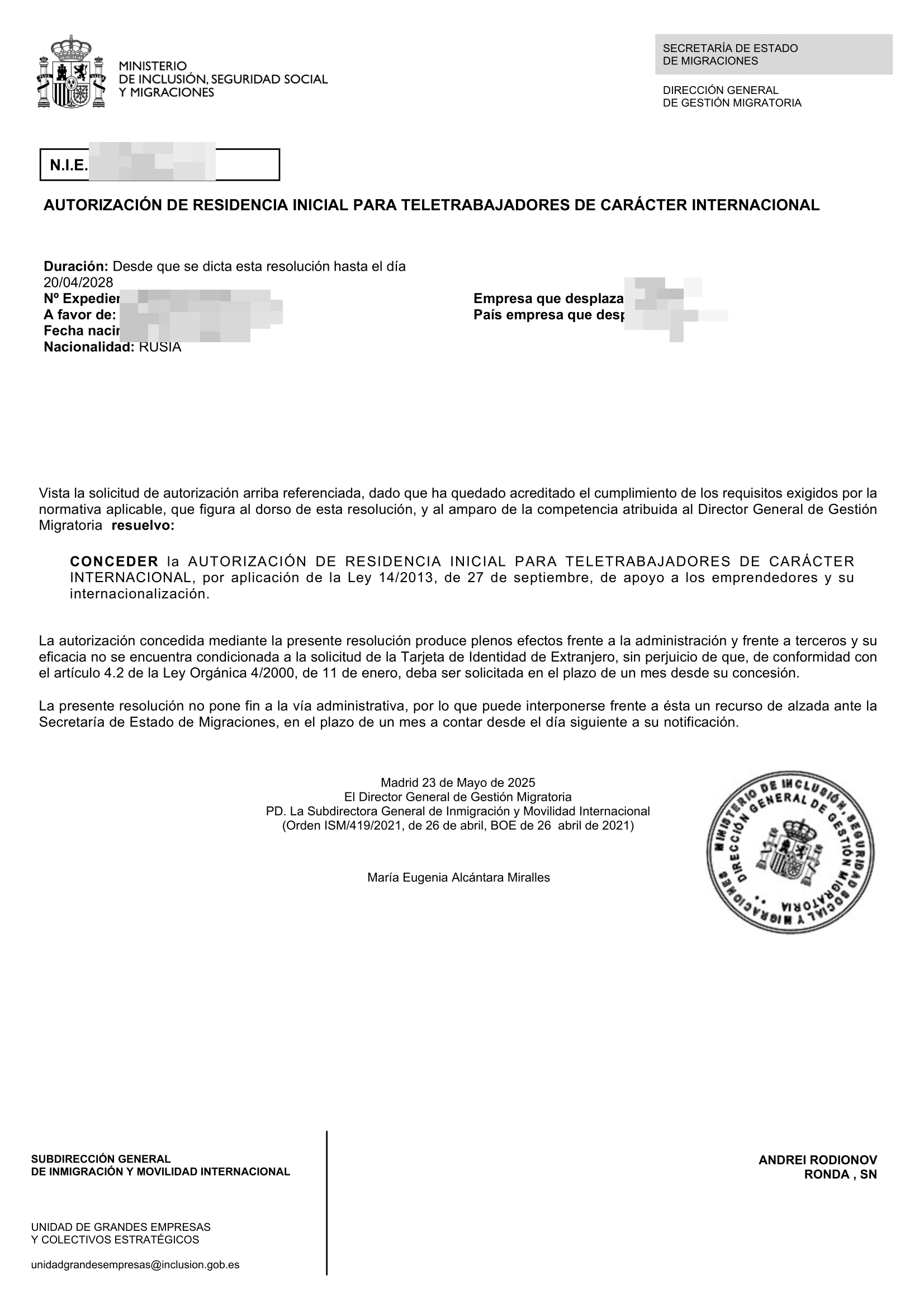
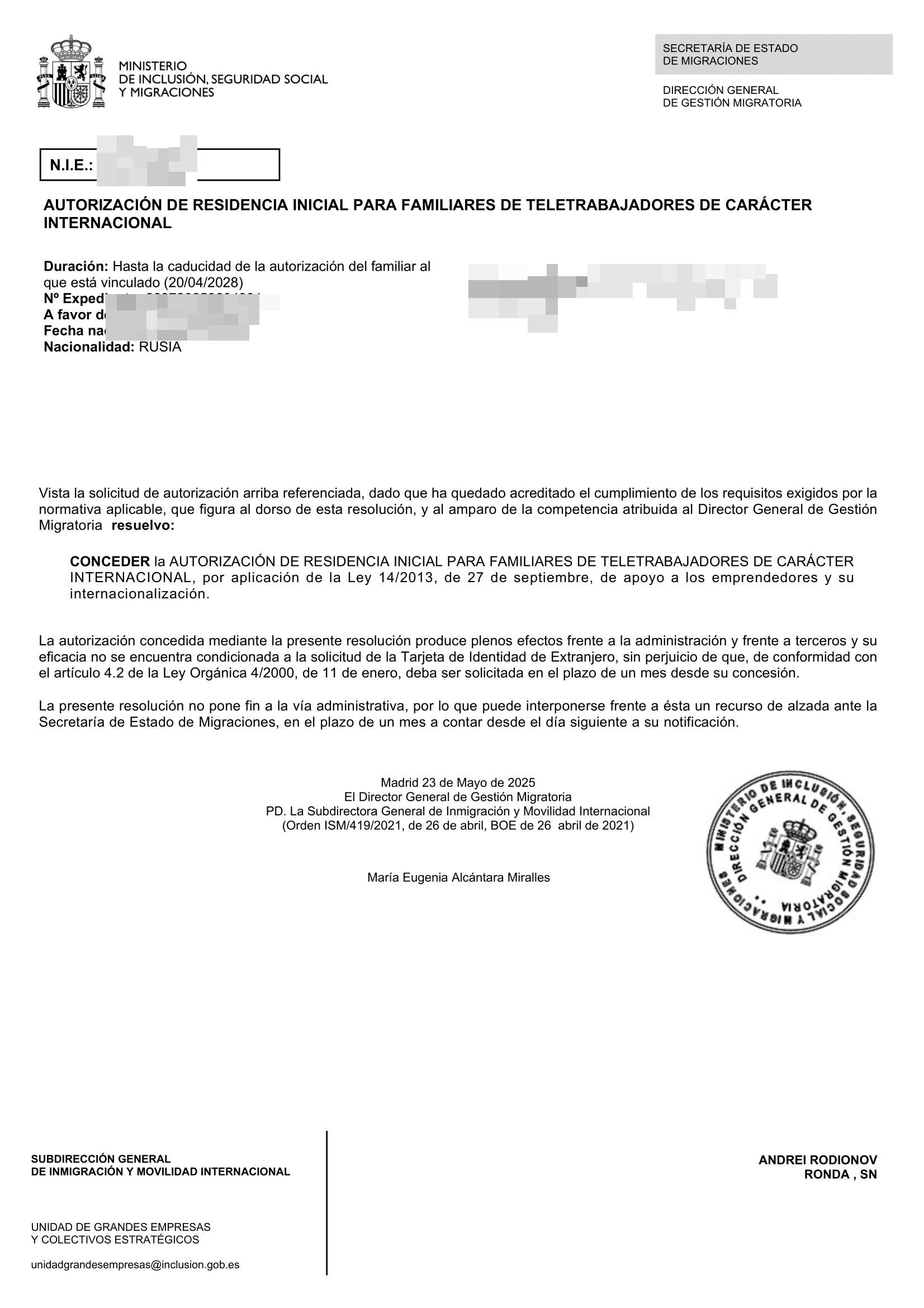
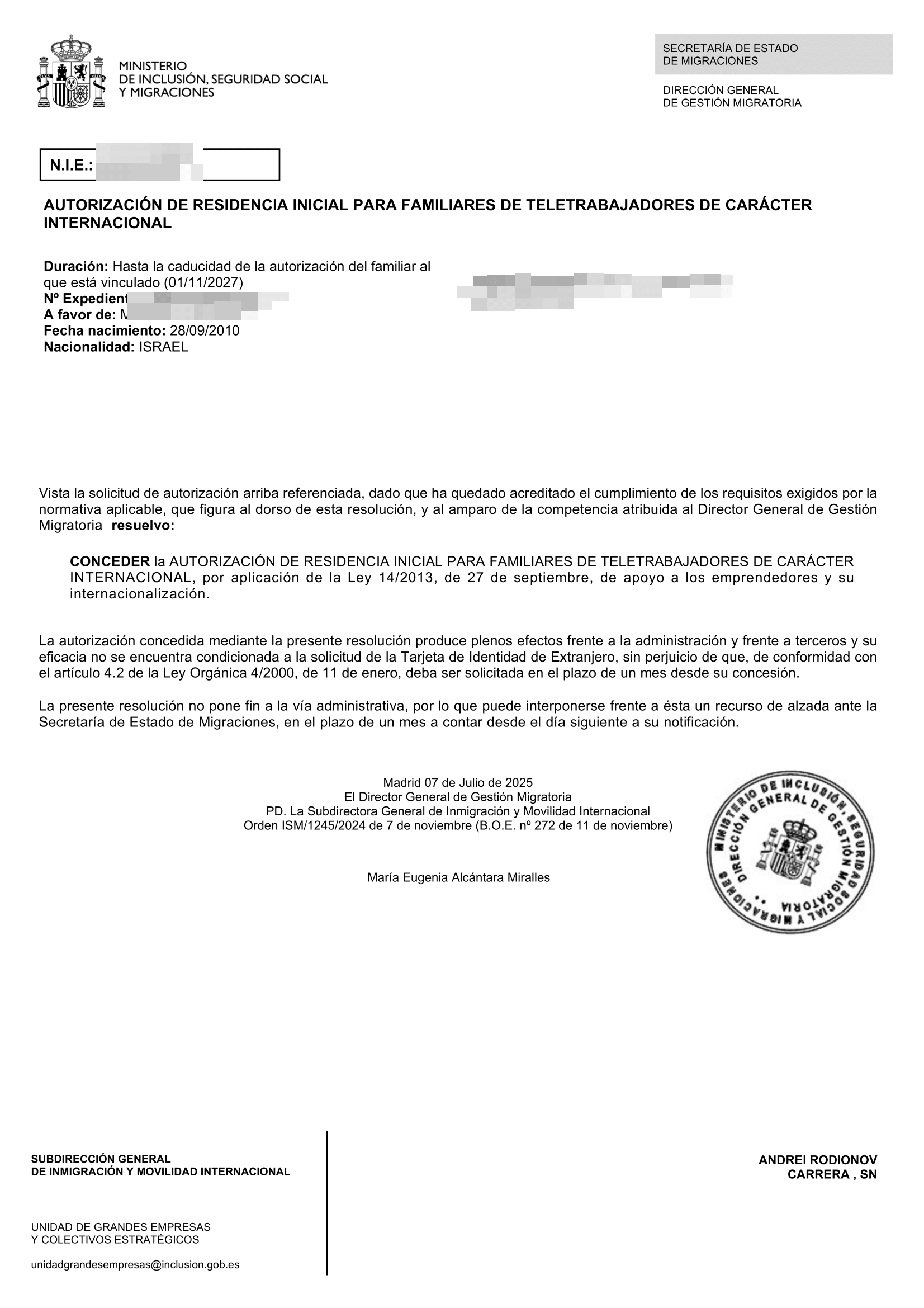
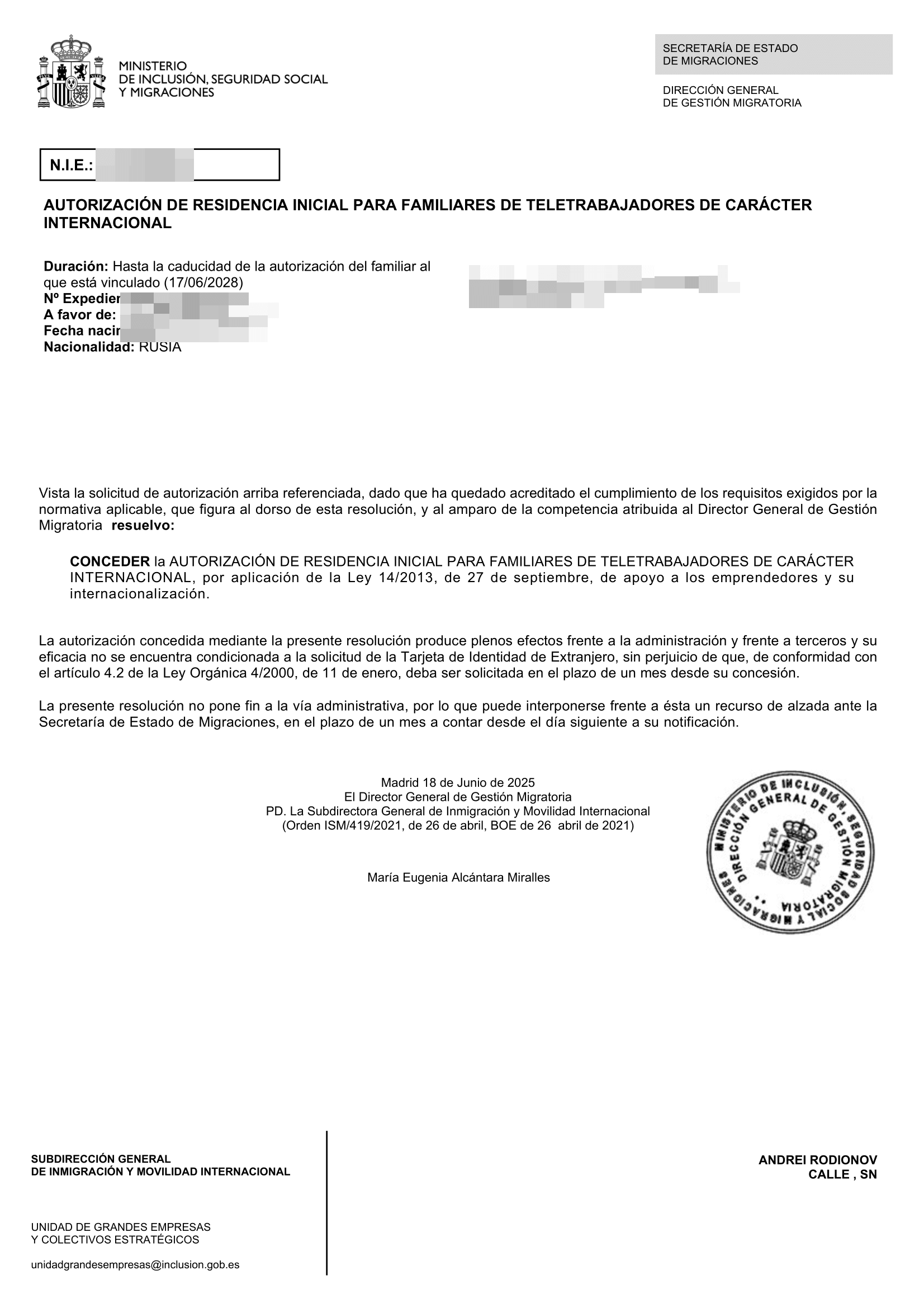
Official decisions from Spain's immigration system (Extranjería). Client names and file numbers redacted.
Who Has Relocated to Spain With Our Help
Over 400 Spanish residency cases since 2022. Breakdown by profession — percentages reflect our clients overall across the whole practice (illustrative of the overall client mix):
Insight: What matters most is matching the right permit to your specific situation — profession is one of many variables.
Life in Spain — What It Actually Looks Like
Relocating to Spain is not just paperwork. The lifestyle shift starts from day one. Here is what your new context looks like after receiving your permit.
Ready to start your Spain chapter?
Ready to start your Spain chapter? →Our Process
Consultation
We analyze your situation — income type, family, budget, timeline — and identify the right permit strategy.
Book a consultation →Documents
We provide a case-specific document checklist and guide you through gathering, translating, and correctly legalizing everything (apostilles, traducciones juradas). For US/UK/CA clients, this includes navigating FBI, ACRO, or RCMP background checks.
Application
We guide the full submission — consulate abroad or in-country, depending on your route.
Result
We stay with you through to TIE card collection and initial settlement (bank account, empadronamiento, healthcare, schools as applicable).
Frequently Asked Questions About Moving to Spain
Can I move to Spain without speaking Spanish?
Yes. Spanish is not a formal requirement for most permit applications. However, basic conversational Spanish is a practical necessity for daily life — healthcare, banking, landlords, and schools all run on it. Learning before you arrive helps considerably.
Is it realistic to move to Spain from the US, UK, or Canada in 2026?
Yes — legal routes are open and actively used. The details of which consulate handles your application, what appointment slots are available, and current processing volumes all matter. We verify these before any submission.
How much money do I need to get started?
A practical planning range is €4,500–€8,500 covering fees, document preparation, and first-month living costs. The spread depends on your city, family size, and permit type. See the cost breakdown above → EUR is the source of truth; USD/GBP are approximate.
Can I bring my family?
Yes. Most permit types allow including a spouse and dependent children (subject to financial thresholds) or pursuing family reunification once you hold residency.
Which Spanish city should I choose?
Madrid — strong infrastructure and job market, higher cost of living. Barcelona — international atmosphere, also expensive and competitive. Valencia — excellent cost-to-quality ratio, strong expat community. Malaga — mild climate, growing hub for remote workers.
How long does the process take?
Typically 1–6 months, depending on permit type and application route. The Digital Nomad Visa tends to be faster when income documentation is solid and the file is clean.
Can I work in Spain on a residence permit?
It depends on the permit. Digital Nomad: remote work only (non-Spanish employers/clients). Work permit: yes, local employment. Non-Lucrative: no work. Student: up to 30 hours per week.
What about taxes when living in Spain?
Taxes. Living in Spain has tax implications both in Spain and in your home country. We are not tax advisers — where tax matters arise, we coordinate with a qualified cross-border tax adviser. A detailed tax guide will follow. (Nothing here is tax advice.)
Ready to Begin Your Relocation?
Book a consultation — we'll review your situation, identify the right permit type, and build a step-by-step plan.