
How to Open an SL in Spain — Spain's Version of an LLC: Step-by-Step Guide 2026
An SL (Sociedad Limitada, "limited company") is the closest Spanish equivalent to an LLC or Ltd. We've walked clients through this process more than once, working alongside a gestoría (a Spanish firm handling administrative, tax, and registration paperwork) and a bank that take on most of the heavy lifting. This guide lays out the full roadmap for opening a company in Spain, based on one real case, with the actual documents and figures: what happens at each step, what it costs in practice, and where providers most often drop the ball.
Company formation rules, fees, and processing times in Spain can change. This guide reflects one client's experience and general Spanish company-law practice as of 2026; it is not a substitute for advice from a qualified Spanish lawyer or gestoría, and it does not cover US, UK, or Canadian tax consequences of owning a Spanish company. Verify current rules before you act.
What an SL Is and Who Runs the Process
An SL (Sociedad Limitada, full legal name Sociedad de Responsabilidad Limitada) is the Spanish equivalent of an LLC or private limited company: a limited-liability entity where founders are liable only up to the value of their share capital, the company pays corporate tax (Impuesto de Sociedades), and it can hire employees. So if you've been searching "how to set up an LLC in Spain," the SL is the vehicle you're looking for.
It's possible to open an SL entirely on your own, but almost no one does it that way in practice. The typical path is to work with a gestoría and a bank that run the process for you — from the name check through to registering with the tax authority. Founders mainly need to supply information on time and carefully review every draft document before it's signed — more on that below. The whole process usually takes 2 to 4 weeks; the longest step is registration with the Commercial Registry.
Step 1: Choosing a Name and Reserving It at the Commercial Registry
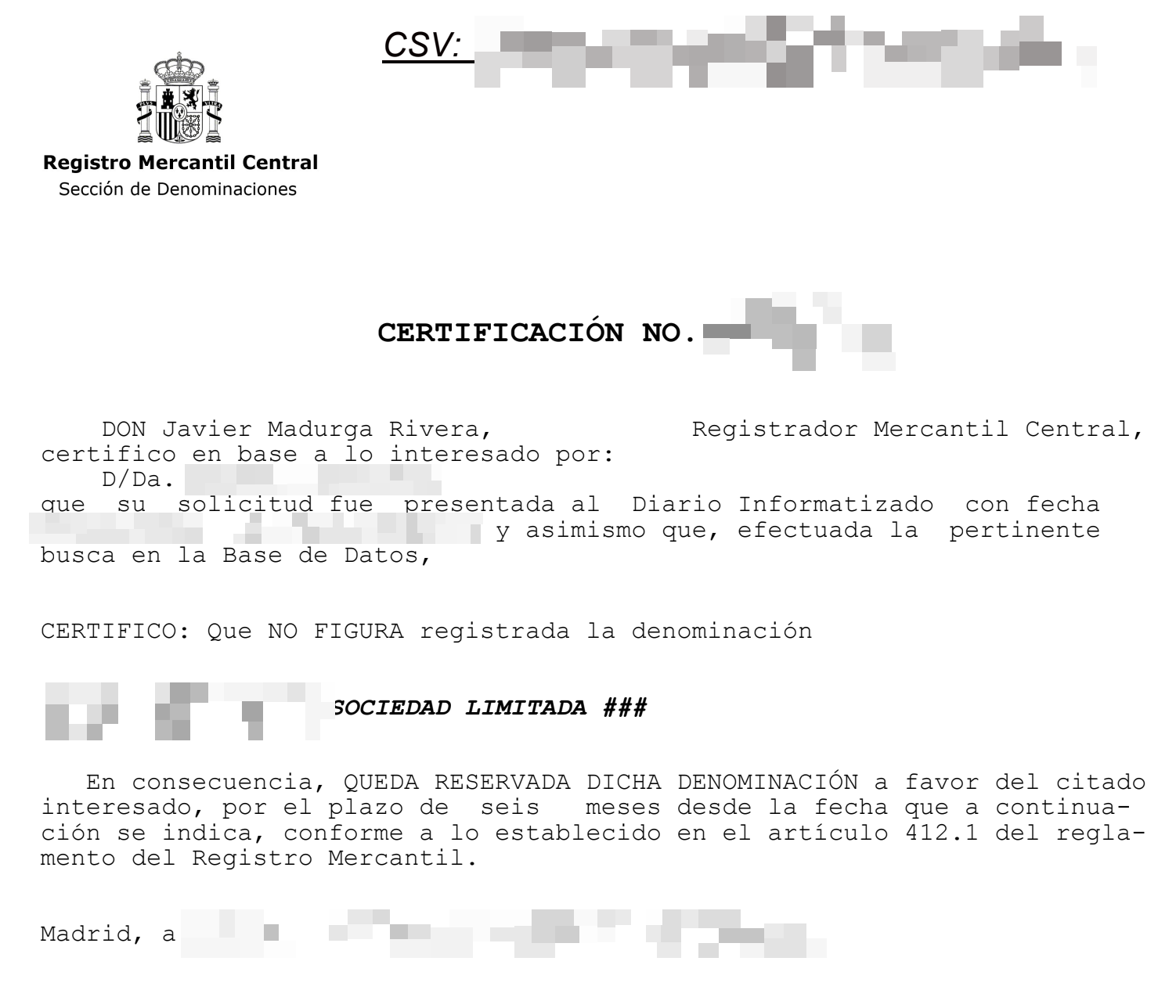
First, you need a company name. In Spain, no two SLs can share the same name, so every proposed name is checked against the central Commercial Registry — the Registro Mercantil Central. This check and the request itself are usually handled by the gestoría.
- Come up with 3 to 5 name options, ranked by preference. If your first choice is taken, the registry moves down your list automatically, so you don't lose time with a repeat request.
- The gestoría requests a certificación negativa de denominación from the Registro Mercantil Central — a certificate confirming the name is available and reserved for you. The official registry fee runs around €16–€20; in the case covered here, with the gestoría's processing included, the total came to €42.
- The notary will need this certificate to draw up the bylaws, so don't wait too long: it has a limited validity (3 months for use before a notary; the name itself is reserved for 6 months).
Step 2: Founder (and Spouse) Details
Once the name is settled, the gestoría collects information on every founder. Prepare this in advance — here's what they'll ask for each person:
📋 What's Needed for Each Founder
- Full name — exactly as it appears on your passport / NIE
- Tax ID number — NIE (for residents) or NIF
- Residential address
- Ownership share — how participation is split among founders
- Marital status — and, if married, your matrimonial property regime
- Spouse's details — if the founder is legally married
Why the Notary Asks About Marital Status
This question tends to surprise founders, but the logic behind it is straightforward: a Spanish notary is required to record each founder's marital status in the constitutive deed (escritura), along with the matrimonial property regime (régimen económico matrimonial) that applies to the marriage. Which regime applies depends on the law under which you married — this varies by US state (community-property states work differently from common-law states), by UK jurisdiction (England & Wales vs. Scotland), and by Canadian province (Québec's default regime differs from the common-law provinces). Confirm the correct answer with your own lawyer before your notary appointment — the gestoría can guide you through the Spanish paperwork, but not through foreign family law.
- If shares are paid for out of joint marital funds, their value may be treated as joint marital property — but voting and management rights stay personal to whichever spouse is named as the founder in the bylaws.
- For a cash contribution to the share capital, spousal consent is not required — you only need to record the spouse's details.
- If the contribution is non-cash (equipment, property, etc. drawn from joint marital assets), the spouse will likely need to appear before the notary and sign as well.
Practical takeaway: if you're married, have your spouse's passport details ready ahead of time. The gestoría will handle the paperwork, but without this information the drafts will stall.
Step 3: The DUE — Capital, Business Activity, and Administrator
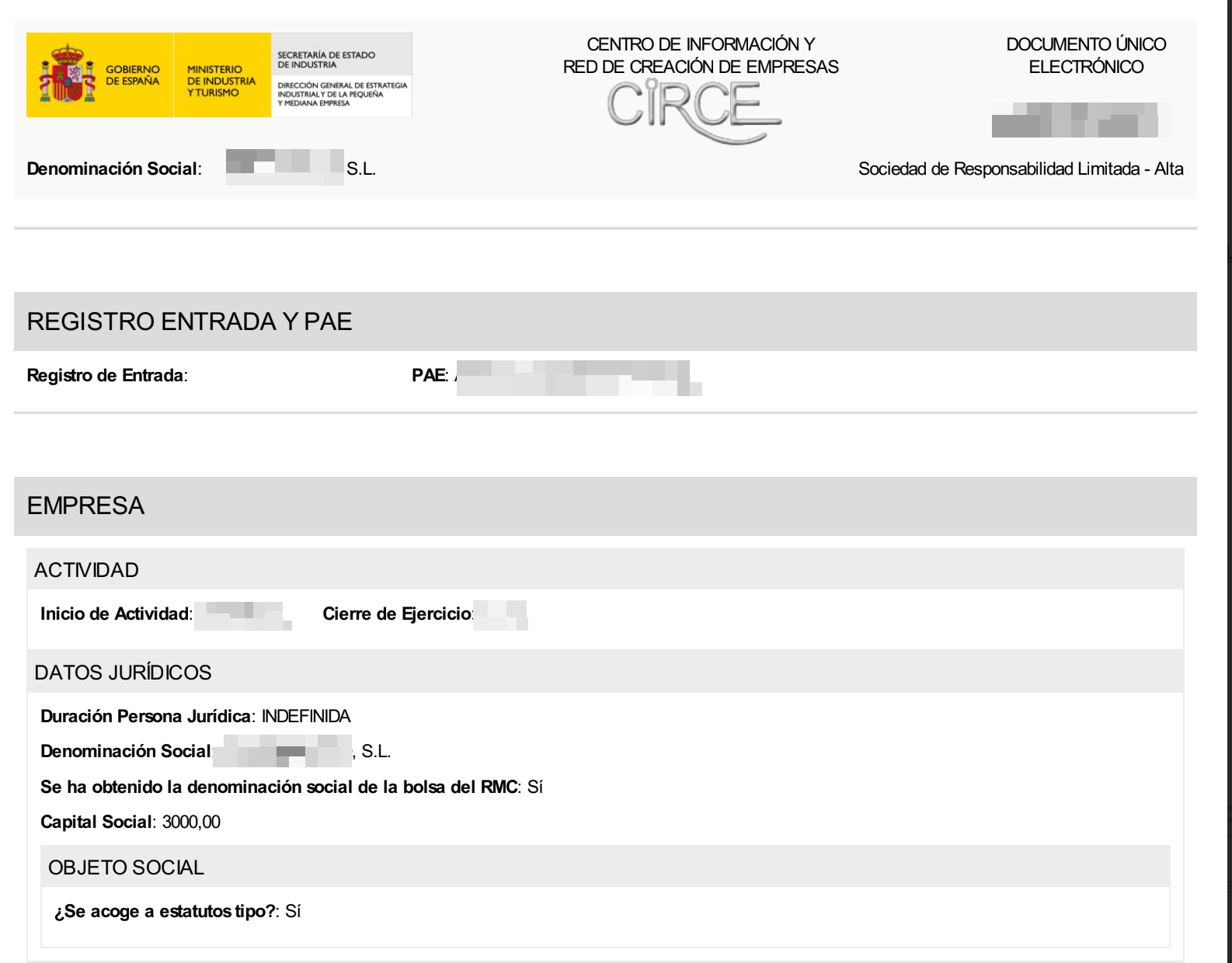
Next, together with the gestoría, you complete the DUE (Documento Único Electrónico, "single electronic document") — the master filing sent to the tax authority and other government bodies with all of the company's details: who the founders are, what the company does, and where it operates. In effect, it's the future SL's application form.
What it records:
- Founders' addresses and the company's registered address — where it will operate;
- Business activities (actividades) — activity codes from Spain's classification system, similar to a NAICS/SIC code;
- Share capital — see below;
- Marital status of founders and their spouses' details;
- Start date from which the company is considered operating;
- Administrator — who runs the company.
Share Capital: €3,000 or €1?
The traditional minimum capital for an SL is €3,000. Since 2022, Spain's Ley Crea y Crece ("Grow and Create" law) allows an SL to be formed with as little as €1, with conditions: until capital plus reserves reach €3,000, the company cannot distribute dividends, 20% of annual profit must go to a legal reserve, and on liquidation with unpaid debts, founders are jointly liable for the shortfall up to €3,000. For that reason we generally recommend depositing €3,000 up front — it's a figure that doesn't raise questions with banks or business partners. One important practical point:
Capital is deposited after the bank account is opened — you don't need to open an account and fund it beforehand. The order is: sign at the notary, then open the account, then deposit the capital.
Administrador — the Company's "CEO"
Every SL appoints an administrador ("administrator") — in plain terms, the person who runs the company and signs on its behalf, similar to a managing director or CEO. There are a few structures: a single administrador único (the most common setup), or several joint or several administrators acting together or independently. The remaining founders stay on as plain shareholders. Two things worth understanding upfront:
- Liability for the company's operations falls mainly on the administrator;
- An administrator who is also an owner registers as an autónomo societario ("self-employed via a company") — meaning they enroll in Spain's social security system as self-employed through the company and pay a monthly contribution.
Step 4: Notary, CIF, and Modelo 036
Once the DUE is ready and the name certificate is in hand, the gestoría books a notary appointment. You'll receive draft bylaws and the constitutive deed before the appointment.
In our experience, every provider makes mistakes somewhere, and errors at this stage are the most expensive to fix: a misspelled name, the wrong ownership share, or the wrong business activity in the bylaws means a separate trip back to the notary and extra fees. Read every draft before signing.
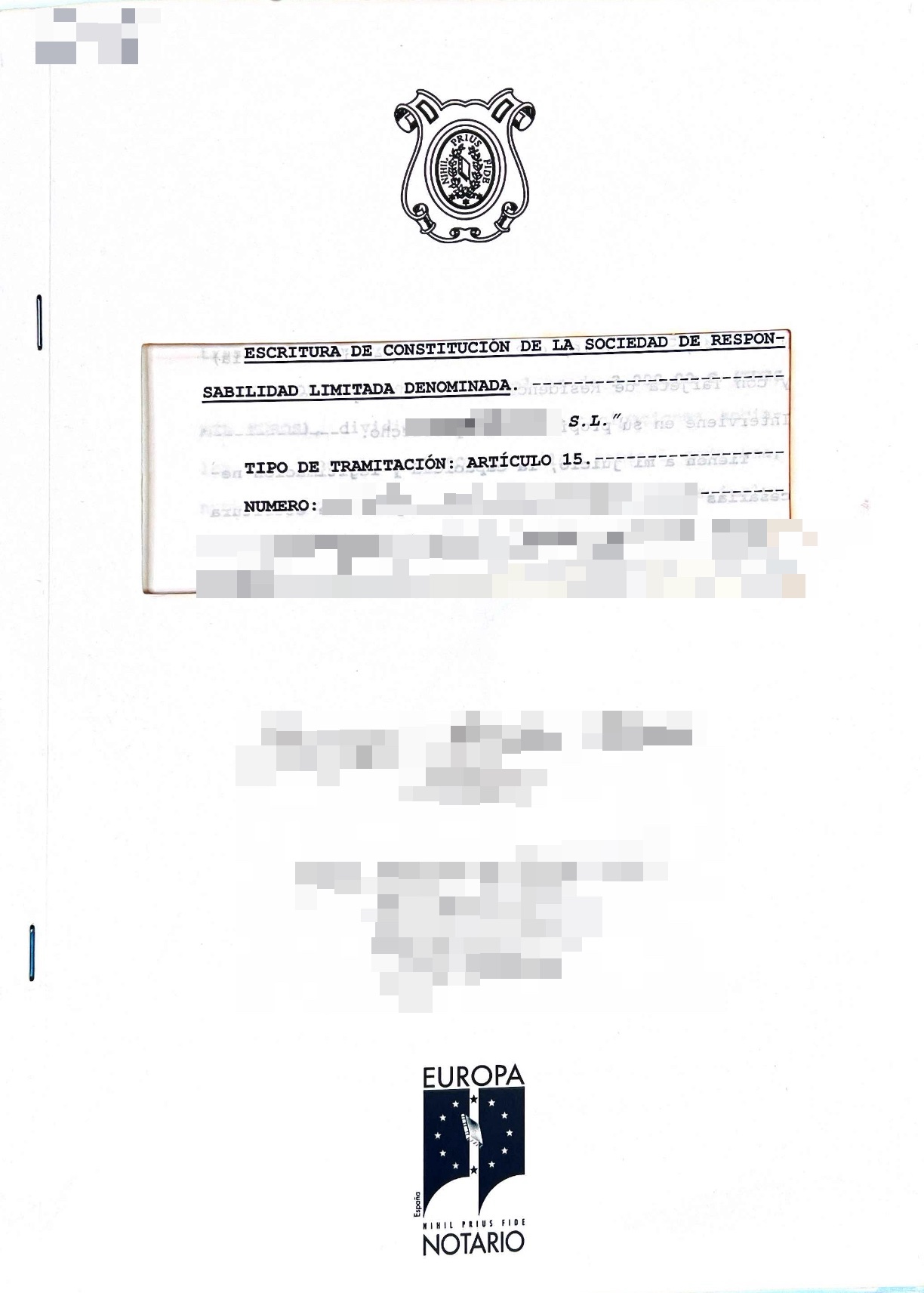
- Signing at the notary. On the scheduled day, all founders attend in person (if someone can't make it, a power of attorney can be arranged in advance) and sign the bylaws (estatutos) and the constitutive deed (escritura de constitución). In this case, the notary's fee came to about €300.
- CIF issued the same day. The company is immediately assigned a CIF (officially now called the company's NIF) — its tax ID number, equivalent to an EIN. It's provisional at first (valid 6 months) and becomes permanent once the company is entered in the Commercial Registry.
- Modelo 036. Form 036 is filed to register the company with the Spanish tax authority (Agencia Tributaria): company details, business activities, tax regimes. The gestoría handles this too.
- In parallel, the Registro Mercantil Central confirms the name is locked in for the company, and the deed is sent for registration with the Commercial Registry — the longest step, usually 7 to 15 business days.
Step 5: Opening a Bank Account and Depositing Capital
With the deed and CIF in hand, you can open a bank account. In this case the founders chose the French neobank Qonto, an online business bank that also offers a turnkey SL-formation service. Once the account is open, the share capital is deposited — founders simply wired it from their personal accounts. At that point the formal side is done: the company exists and the account is active.
It's a fine bank for getting started, nothing more, nothing less. But there's one important limitation: Qonto isn't fully connected to Spain's government direct-debit system (domiciliación). It already supports payments to the tax authority (AEAT), but not social-security (Seguridad Social) direct debits. That's fine while you're working solo; once you're ready to hire employees and pay their social-security contributions, you'll need a traditional local bank.
Step 6: A Local Bank — When and Why You'll Need One
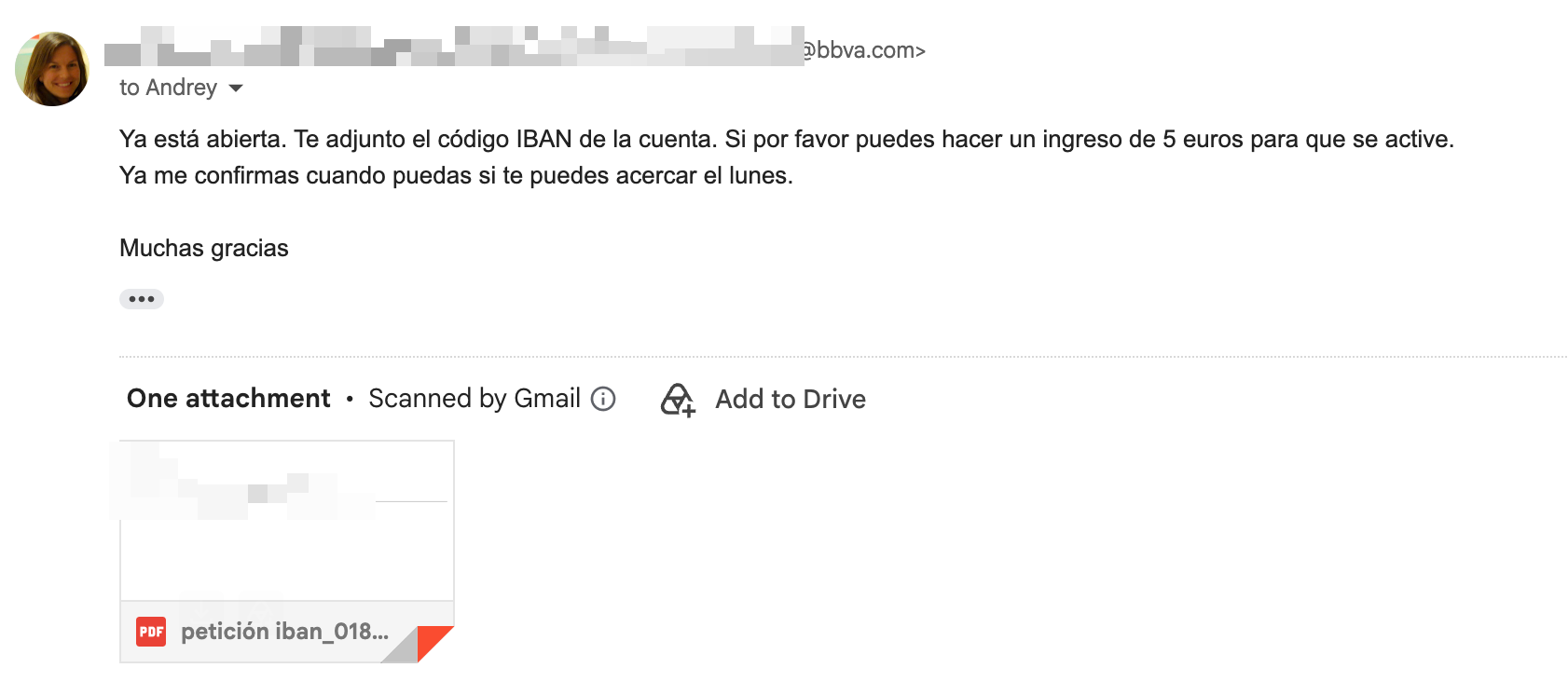
To hire employees and run full payroll, you'll need an account at a traditional local bank — BBVA, CaixaBank, or Santander. In this case the founders chose BBVA, and this is where things get harder: Spanish banks apply significantly more scrutiny to newly formed companies and to founders without an established banking history in Spain than to an individual's personal account. Opening a personal account tends to go smoothly; opening a corporate account is much more a matter of your relationship with a specific branch.
What works in practice:
- Go to the branch where you already bank as an individual. In this case, the founder went to the BBVA branch where he'd already been a personal customer for several years, and helped resolve the same question for friends going through the same process. If you don't already have a branch, ask for an introduction from someone who has already opened an SL account.
- Meet the bank in person, even if you need to bring an interpreter. Third-party fixers can charge disproportionate fees, but that's not the main issue — you, not them, will be the one dealing with the bank afterward. A direct relationship with the branch manager or the person who handles SL accounts solves most future friction.
- Be proactive. Before a large transaction, notify the bank in advance: "We're planning this transaction — please confirm you're comfortable with it." In this case that approach meant no follow-up questions from the bank at all.
How Much Does It Cost to Open an SL: Real Costs
| Cost item | Amount | Notes |
|---|---|---|
| Name certificate (Registro Mercantil Central) | €42 | Certificación negativa de denominación (official fee ~€16–€20; the rest is the gestoría's processing fee) |
| Notary | ~€300 | Bylaws, deed, and the full document package |
| Gestoría | ~€300 | End-to-end support through the whole formation process |
| Share capital | €3,000 | Not a cost: this money stays in the company's account and works for the business |
Approximate, FX-dependent (EUR is the source of truth throughout): all told, opening this SL cost around €650 in fees and government charges, plus €3,000 in share capital that remains company money.
Frequently Asked Questions About Opening an SL in Spain
How much does it cost to open an SL in Spain?
In the case covered in this guide, around €650 total: about €42 for the name certificate, about €300 for the notary, and about €300 for the gestoría. On top of that comes €3,000 in share capital, which is not a cost — that money stays in the company's bank account.
How long does opening an SL take?
Usually 2 to 4 weeks from the name request to a fully registered company. The longest step is entry into the Commercial Registry after the notary signing (7 to 15 business days). The company gets its CIF the same day it signs before the notary and can begin operating.
Can you open an SL with €1 of capital?
Formally yes — Spain's Ley Crea y Crece allows it. But until capital plus reserves reach €3,000, you can't distribute dividends, and 20% of profit must go to a legal reserve every year. In practice it's simpler to deposit €3,000 up front — that money isn't lost, it stays as working capital for the company.
Can a US, UK, or Canadian citizen open a company in Spain?
Yes. Registering an SL requires an NIE (Número de Identificación de Extranjero, Spain's foreigner ID number) for every founder. Registration itself usually goes smoothly regardless of nationality — the main friction point is banking: Spanish banks apply extra scrutiny to newly formed companies and non-resident founders, and a personal relationship with the branch plus proactive communication make a real difference.
Practical Takeaways
- Check every draft document — especially during company formation. This is the single most important rule: follow it, and any provider's mistake stops being a real problem.
- There's no such thing as a flawless gestoría — every provider makes mistakes somewhere. Favor established local providers over informal intermediaries, and periodically double-check their work.
- Build a real relationship with the bank. A direct connection with a branch that knows you is worth more than any third-party fixer.
- Be proactive about everything. Give the bank advance notice of large transactions, and you'll avoid most follow-up questions.
- The combination used in this case: gestorías Finutive and Enley, starter bank Qonto, and BBVA as the main bank. The result was solid overall — with the caveat above about checking every draft.
Once this is done, the company is fully ready to operate: it can invoice clients, sign contracts, and hire staff. If you're relocating to Spain by starting your own business, you'll typically also need documentation proving your professional or business history — see our guide on company & employment proof.
Prefer to Have Someone Handle It?
We can help fit opening an SL into your broader relocation strategy — from choosing the right visa type to collecting your residence card.
✈ Get in Touch