
Pareja de Hecho in Spain 2026: How to Register, Costs, and Dissolution
In my work with clients on Spanish residency, I regularly find that pareja de hecho (registered domestic partnership) is misunderstood as simply a "lightweight marriage." It is not quite that. In practice it is a distinct legal instrument — and a very useful one, especially when the goal is to obtain residency or to establish a partner's legal status in Spain. This guide covers everything: why register, who can do it, how the process works, what it costs, and how to dissolve it.
1. Why Register a Pareja de Hecho
In the majority of cases, my clients register a pareja de hecho in Spain in order to establish or extend their legal residency.
The main situations it resolves:
- Applying for a residence permit jointly with a partner
- Obtaining a residence permit for the partner of an EU citizen or EU resident
- Access to the Spanish public health system
- Formal recognition of the relationship in legal and administrative matters
- In some regions — tax and social benefits
- Rights and requirements differ significantly between Spain's autonomous communities — for example, Madrid and Catalonia have different rules and legal consequences.
- Pareja de hecho is not an equivalent of marriage — it is a more flexible but also less universally recognized instrument.
2. Who Qualifies for a Pareja de Hecho
A pareja de hecho can be registered by:
- Two adults (both aged 18 or over)
- Neither of whom is currently married
- Who are not close blood relatives
- Who are cohabiting or intend to cohabit
In my experience, the most common scenario among expat clients is:
Both partners are non-EU nationals. Registration is needed to formalize the relationship, support a joint residency application, and address practical legal matters in Spain.
Some regions require evidence of cohabitation (typically through a joint empadronamiento — town-hall registration at the same address), but requirements vary by region and by individual notary.
3. How to Register a Pareja de Hecho
The procedure depends on the region, but the general process I work through with clients is as follows:
-
Step 1 — Prepare Your Documents
Standard document pack:
- Passports of both partners
- NIE (Número de Identificación de Extranjero — Spanish ID number for foreigners), if already issued
- Certificado de empadronamiento (town-hall registration certificate) showing the same address, if you already have joint registration in Spain
- Evidence of a genuine, ongoing relationship — photos, shared travel records, correspondence. If you have children together, that is strong documentation. There is no fixed minimum cohabitation period for the notarial route, but the more supporting material you can provide, the smoother the process [TODO: confirm current regional requirements with your gestor before filing]
- Application statement (usually completed at the notary's office)
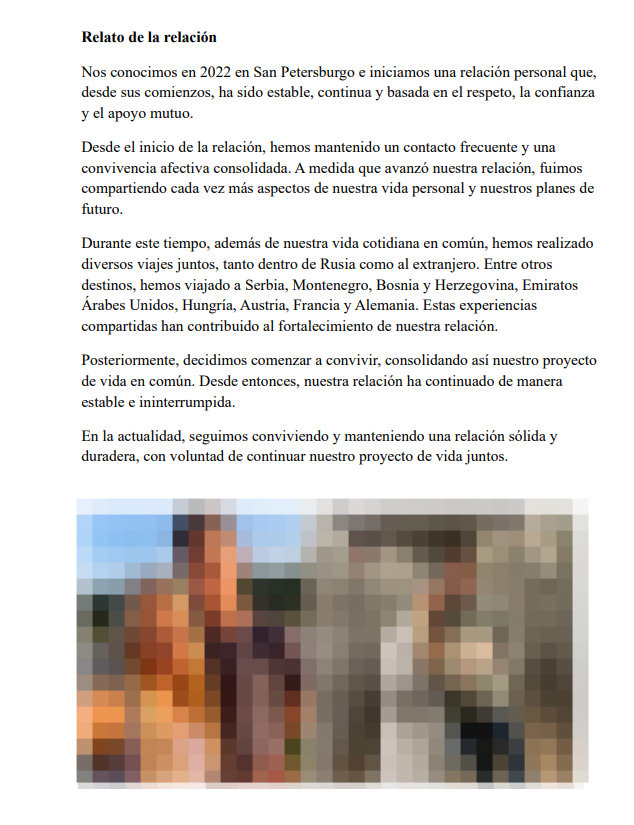
Example relato de la relación — a written account of the relationship history, supported by photos, travel tickets, and correspondence. Submitted alongside the application. -
Step 2 — Submit the Application
The application is filed through a notary. The notary's office will schedule a specific date for you. Both partners must attend in person with passports and all required documents.
The registration requires two witnesses — they must be Spanish residents or citizens. Their role is to confirm that the relationship is genuine.
An interpreter may be required if neither partner speaks Spanish or English.
-
Step 3 — Receive Your Certificate
After registration you receive an official document confirming your pareja de hecho status.
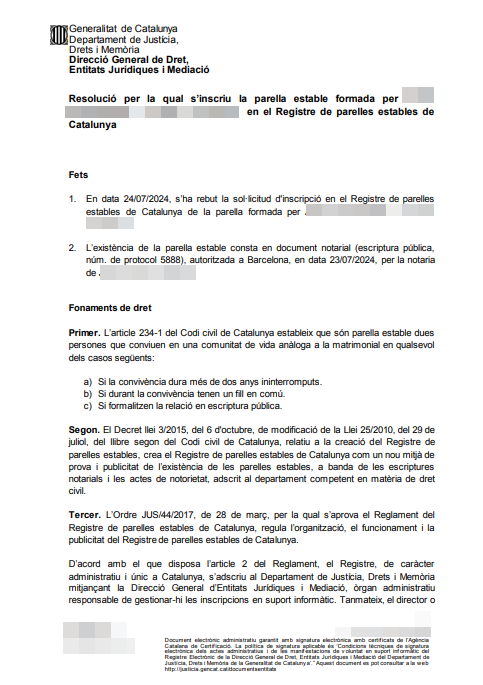
Sample pareja de hecho certificate (Catalonia), page 1. 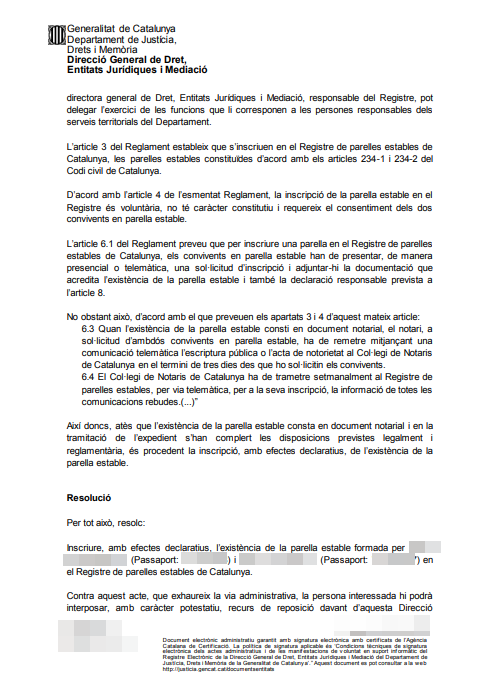
Same resolution, page 2. Once registered, you can:
- Apply for a residence permit (jointly or as the partner of a resident)
- Arrange private or public health insurance coverage
- Use the status in other legal and administrative procedures
4. Costs
Cost depends on the registration route and how much document preparation is needed. Based on current experience:
💰 Via a Notary
- Notary fees: typically €150–€300 [TODO: confirm current notary fee schedule for your city before quoting clients]
- Additional: certified translations of foreign documents by a sworn traductor jurado
- Additional: professional support / gestor fees, if applicable
When foreign documents require certified translations and apostilles, clients typically spend €300–€800 in total. Costs vary considerably by region and by individual notary.
5. Dissolution
Dissolution is a relatively simple procedure. The main routes are:
-
By mutual agreement
- Both partners submit a joint application
- The registration is cancelled
-
Unilaterally
- One partner may file the application alone
- The other partner is formally notified
-
Automatic termination
- Either partner marrying someone else
- Death of either partner
- In some regions — permanent cessation of cohabitation
If the pareja de hecho was used as the basis for obtaining a residence permit, dissolving it can affect that permit — the residency may no longer be valid. In these situations I always recommend assessing the risks in advance and planning next steps carefully before filing for dissolution.
Summary
From a practical standpoint, pareja de hecho is:
- A useful instrument for establishing legal residency status
- Faster and simpler to obtain than marriage
- But one that requires attention to regional rules and immigration implications
Used correctly, it genuinely solves a range of problems — particularly for non-EU nationals navigating the Spanish immigration system together.
Prefer to Have Someone Handle It?
We manage pareja de hecho registration and the full residency process — from document preparation to collecting your residence card.
✈ Get in Touch