
How to Check Your Remaining Schengen Days Online — Official EU EES Tool
US, UK, and Canadian passport holders don't need a visa for short trips to Spain or the rest of the Schengen Area — but the 90-days-in-any-180-day limit still applies, and it is now tracked automatically at the border. The EU's official Entry/Exit System (EES) publishes a free, no-login tool that lets you look up exactly how many of your 90 days remain, using nothing more than your passport number.
How it works
The Entry/Exit System (EES) began rolling out at Schengen borders on October 12, 2025, and became fully operational at every external border crossing point on April 10, 2026. It replaces manual passport stamps with an electronic record: every time a non-EU short-stay traveler crosses a Schengen external border, the date, document number, and (on first crossing) biometric data are logged automatically.
Because your entries and exits are now recorded electronically, the EU publishes an open lookup tool so you can check your own balance under the 90/180-day rule at any time. Enter your passport number and travel details, and the system responds with either "Authorised stay: OK" plus a count of remaining days, or an indication that your allowance is not currently available for the date you entered.
The check is free and anonymous — no account, no visa application number, no fee. All you need is the passport number you travel on.
Who this tool is for — and who it isn't
This tool is built for short-stay, visa-exempt travelers — tourists, business visitors, and remote workers making exploratory trips to Spain before deciding whether to relocate. It answers one question: how many of my 90 short-stay days, in the current 180-day window, do I have left?
If you have applied for a long-stay national visa (for example, through a Spanish consulate as part of a Digital Nomad Visa, Non-Lucrative Visa, or Startup Visa application) or you are already waiting on a residence-card decision inside Spain, this tool will not show your application status — long-stay (D-type) authorizations sit outside EES by design. Track that process instead through the official portal icp.administracionelectronica.gob.es, covered in our TIE card status guide.
Step-by-step instructions
-
Go to the official EU check page:
travel-europe.europa.eu/ees/check-how-long-you-can-stay -
Fill out the form:
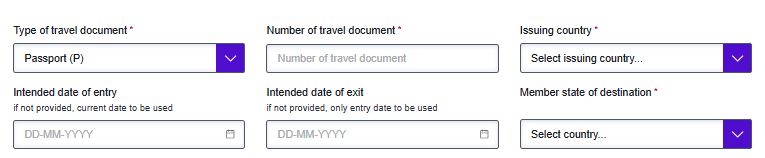
The check form — five fields, all in English - Type of travel document — Passport (P);
- Number of travel document — your passport number;
- Issuing country — the country that issued your passport (United States, United Kingdom, Canada, etc.);
- Intended date of entry — the date you plan to enter (or already entered);
- Member state of destination — the Schengen country you're entering, e.g. Spain.
-
Complete the anti-spam check: move the slider to the indicated number and click Submit.
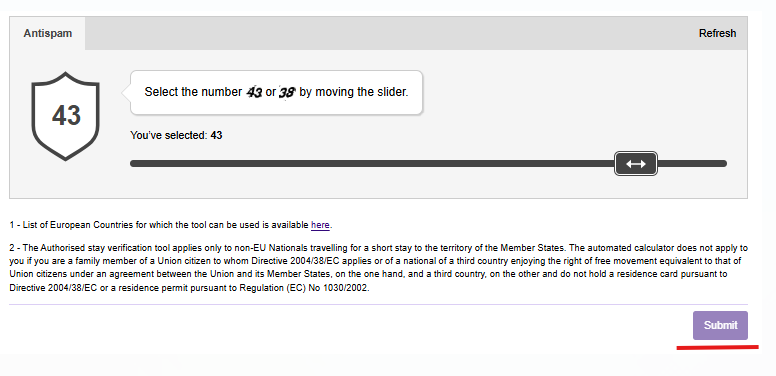
Move the slider to the requested number, then submit the form
Understanding your result
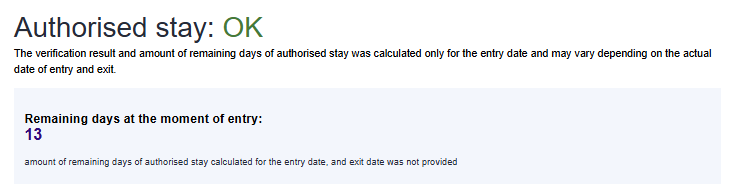
✅ "Authorised stay: OK"
Along with the status, you'll see a remaining-days count (for example, Remaining days at the moment of entry: 13). This means that, based on your recorded entries and exits, you have that many short-stay days left for the entry date you specified. If you have not yet made any Schengen trip since the system went live, expect to see your full 90-day allowance.
⚠️ "Not OK", or zero / negative remaining days
First, re-enter your passport number and dates manually rather than pasting them — copy-paste sometimes carries over stray spaces or invisible characters that produce an inaccurate result. If the result doesn't change, take it seriously: it typically means the system does not currently show enough remaining allowance for the entry date you gave, which can point to an overstay risk. Don't make a booking or travel decision based on a borderline result without double-checking your dates and, if needed, consulting a qualified immigration professional.
It's worth checking before you book a trip, not just after — especially if you've made several short visits to Spain or elsewhere in the Schengen Area in the past six months and have lost count of your exact days used.
Tired of counting days? There's a way out
If you're reading this because you're juggling trip dates, watching the 90/180 clock, and wondering whether you can risk one more visit before your window resets — you're exactly the kind of traveler this rule was designed to limit. A Spanish residence permit removes the 90/180 constraint entirely, and for remote workers it's often more accessible than people expect:
- 3 years of legal residency up front — renewable for 2 more. No more counting days between trips.
- The 90/180 rule stops applying to you — live in Spain as long as you want, and travel freely across the rest of the Schengen Area.
- Your family is included — a spouse or partner and children can apply alongside you, and your partner is permitted to work in Spain.
- Built for remote workers — employed by a company based outside Spain, or self-employed/freelance anywhere in the world. Minimum gross income is currently around €2,849/month (≈ $3,100 / £2,250, approximate and FX-dependent; this threshold is reviewed periodically — verify the current figure before applying). No Spanish-language requirement, and no need for large savings.
- You don't have to live in Spain full-time — there's no requirement to spend 183+ days a year in the country to hold the permit (tax residency is a separate question — see disclaimer below).
- Fast, if filed from inside Spain — by law, a decision is due within 20 business days.
- You can combine the filing trip with an ordinary visit — enter visa-free, file online while you're in Spain, then wait for the decision from wherever you like.
- A path toward permanent residency — after 5 years of residency, you become eligible to apply for permanent residency.
We've put the entire path — requirements, documents, and the pitfalls to avoid — into a free guide. Track record of 400+ successful cases.
📕 Free guide: how to get a 3-year Spanish residence permitWhich countries this covers
The system is unified, so this same tool checks your short-stay balance for any Schengen Area country connected to EES — Spain, Italy, France, Germany, Greece, Portugal, the Netherlands, Switzerland, Austria, Belgium, Denmark, Sweden, Finland, the Czech Republic, Slovakia, Slovenia, Croatia, Hungary, Poland, Romania, Bulgaria, Latvia, Lithuania, Estonia, Luxembourg, Malta, Norway, Iceland, and Liechtenstein, among others.
It does not cover Ireland or Cyprus (both outside EES), or non-Schengen destinations such as the United Kingdom, the United States, or Japan — none of these are subject to the 90/180-day Schengen rule, and each runs its own separate entry system.
EES vs. ETIAS vs. TIE tracking — don't mix them up
It's easy to confuse the different EU travel systems in the news right now. Here's how they differ and which one actually applies to what you're trying to check:
| System | What it tells you | When it applies |
|---|---|---|
| EES (this guide) | Your remaining short-stay days under the 90/180 rule, based on recorded entries and exits | Any time — before, during, or after a short Schengen trip |
| ETIAS | Whether you're pre-authorized to travel visa-free (a separate step, not yet required as of publication) | Before booking, once ETIAS is officially in force — check the official ETIAS site for the current status |
| TIE tracking (icp.administracionelectronica.gob.es) | Whether your Spanish residence card is ready for collection after a residency application is approved | After you've submitted fingerprints for a residence permit — see our TIE status guide |
In short: EES tells you how many free-travel days you have left; ETIAS (once live) will tell you whether you're cleared to travel at all; and TIE tracking tells you whether your residence card is physically ready. None of the three tells you the status of a pending long-stay visa or residence-permit application — for that, your consulate or the immigration office handling your file remains the only reliable source.
Related guides
- Spanish Residency Filing Path Calculator — work out how many trips and how much travel time you and your family need before getting a residence card
- Full Digital Nomad Visa guide — every stage, from documents to your residence card, free
- How to track your TIE residence card status — for after your visa decision, while you wait on the physical card
Frequently asked questions
I'm a US/UK/Canadian citizen — do I even need to worry about this? I don't need a visa for Spain.
Correct — no visa is required for short tourist or business stays of up to 90 days in any 180-day period. But that 90/180 limit still applies, and it's now tracked electronically across the whole Schengen Area through the EES. This tool lets you check your own balance before booking or extending a trip.
Will this tool show the status of my Digital Nomad Visa or Non-Lucrative Visa application?
No. Long-stay national (D-type) visas and in-Spain residence-permit applications sit outside the scope of the EES short-stay tool. If you've already applied and submitted fingerprints, track your card's production status instead through icp.administracionelectronica.gob.es — see our TIE-tracking guide.
What does it mean if the result is "not OK", or shows zero or negative remaining days?
Treat that result seriously. It typically means the system doesn't currently show enough remaining short-stay allowance for the entry date you provided, which can point to an overstay risk. Re-check your dates and passport number for typing errors first, and if the issue persists, consult a qualified immigration professional before making travel plans.
Is travel-europe.europa.eu official and safe to enter my passport number?
Yes — it's the official travel portal of the European Union, hosted on the europa.eu domain. The check is free, requires no account, and no payment.
Does this replace ETIAS?
No. ETIAS is a separate pre-travel authorization that eligible visa-exempt travelers will eventually need before boarding. As of publication, ETIAS has not launched and no confirmed start date has been set — check the official ETIAS site before booking travel close to any rumored start date. EES day-tracking and ETIAS authorization are two different systems that will run alongside each other.
I've never traveled to the Schengen Area since EES went live — will the tool show anything?
Yes. With no recorded entries, the tool will generally show your full 90-day allowance for the entry date you provide. Note that biometric enrollment itself only happens the first time you physically cross a Schengen external border — this online tool doesn't require you to have enrolled already.
Would rather skip the visa-free shuffle altogether?
A Spanish residence permit gets you 3 years of legal status with no 90/180-day limit, and your family can apply alongside you. Minimum requirement: remote employment or self-employment income from outside Spain. We've put the entire path into a free guide — track record of 400+ successful cases. Re-application is included in our fee if your case is refused; see service terms for details.
📕 Get the free guide